
Diagnostic Imaging
Breast MRI vs Mammogram: Which Test Do You Need?
How the two breast tests differ, who needs which, and why doctors often use both
Reviewed by the AIROC Hospitals medical team
In this guide (10)
- Breast MRI or Mammogram: The Short Answer
- Breast MRI vs Mammography at a Glance
- Why Breast MRI Finds More, and Why That Is Not Always Better
- Who Should Have a Breast MRI?
- Who Should Start With a Mammogram?
- Dense Breasts: Where the Choice Matters Most
- What Each Test Feels Like
- Mammogram Cost in Hyderabad
- Breast MRI at AIROC Hospitals, Kondapur
- Frequently Asked Questions
Quick answers
Is a breast MRI better than a mammogram?
It is more sensitive and finds more small cancers, especially in dense breasts, but it also gives more false alarms and can miss some tiny calcium spots a mammogram shows.
Can a breast MRI replace a mammogram?
Usually no. For women at average risk, a mammogram is the standard screening test.
What is an MRI mammogram?
It is another name for a breast MRI. It is not a mammogram at all; it uses a magnet, radio waves and contrast dye instead of X-rays.
Breast MRI or Mammogram: The Short Answer
If your doctor has mentioned both a mammogram and a breast MRI, it is natural to wonder which one you really need, and whether one is "better". Here is the short answer: they are not rivals. A mammogram is the standard first test for breast cancer screening in most women over 40. A breast MRI is an extra, more sensitive test for women at high risk, women with very dense breasts, and people who already have a breast cancer diagnosis.
A mammogram (mammography) is a low-dose X-ray of the breast. A breast MRI (breast magnetic resonance imaging) uses a strong magnet, radio waves and, in most cases, a contrast dye called gadolinium. It uses no radiation at all.
Each test sees things the other can miss. That is why doctors often use them together, along with breast ultrasound, rather than choosing one over the other.
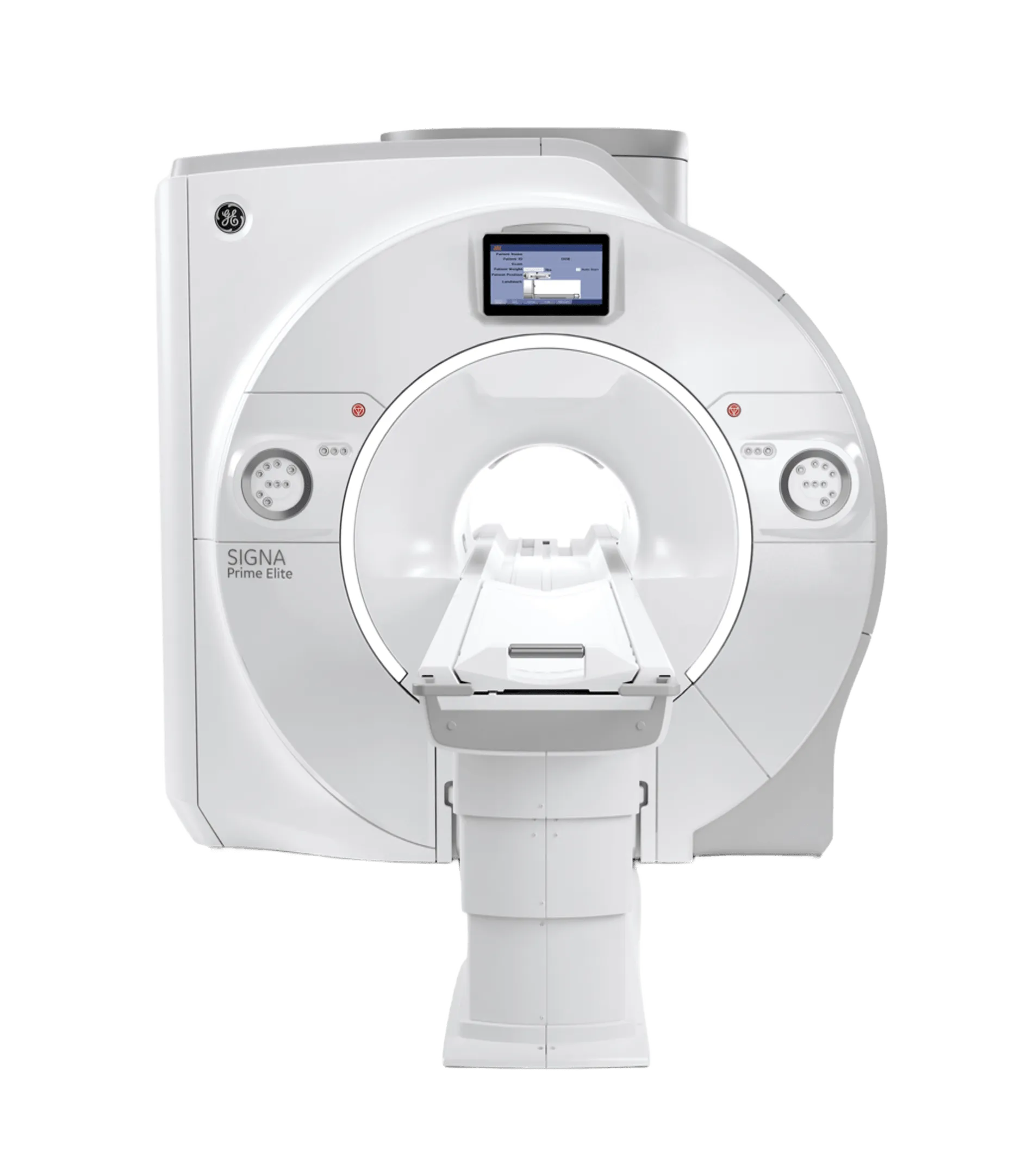
MRI machine image: GE HealthCare.
Breast MRI vs Mammography at a Glance
| Mammogram | Breast MRI | |
|---|---|---|
| How it works | Low-dose X-ray | Magnet, radio waves and contrast dye |
| Radiation | A small dose | None |
| Contrast injection | Not needed | Usually needed (gadolinium) |
| Time on the machine | About 15 to 20 minutes | About 20 to 30 minutes |
| Position | Standing, breast pressed between two plates | Lying face down, breasts resting in a padded coil |
| Best at | Routine screening, tiny calcium spots | High-risk screening, dense breasts, measuring a known cancer |
| Dense breasts | Can hide cancers | Sees through dense tissue well |
| False alarms | Fewer | More, which may lead to extra tests |
| Cost | Lower | Higher |
In simple terms, the mammogram is the everyday screening test, and the MRI is the detailed second look for the right patients.
Why Breast MRI Finds More, and Why That Is Not Always Better
Breast MRI is the most sensitive breast imaging test available. With contrast, it highlights areas with extra blood supply, which is how many tumours show up. It can pick up small cancers, sometimes only a few millimetres across, that a mammogram may not see, especially in dense breasts.
But high sensitivity has a cost. MRI also lights up many harmless spots, such as normal hormone changes or benign lumps. These false positives can mean more scans, a biopsy and weeks of worry for something that turns out to be nothing. And a mammogram still catches some early cancers that MRI can miss, especially tiny calcium deposits (microcalcifications) linked to a type of early cancer called DCIS.
So "more sensitive" does not mean "replace the mammogram". It means "add the MRI when the extra detail is worth it".
Who Should Have a Breast MRI?
Your doctor may advise a breast MRI, usually along with mammography, if:
- You have a high risk of breast cancer, for example a strong family history or a BRCA gene change
- You have very dense breast tissue and the mammogram is hard to read
- You have just been diagnosed with breast cancer, to measure it and check the other breast
- A mammogram or ultrasound result is unclear
- You are having chemotherapy before surgery and the doctor wants to see how the tumour is responding
- You have breast implants and a leak is suspected
For most women at average risk, routine screening starts with a mammogram, and an MRI is not needed. Read more in our guide to breast MRI.
Who Should Start With a Mammogram?
A mammogram is the usual screening test for women aged 40 and above at average risk, repeated every one to two years as advised by their doctor. It is also the first test for many breast symptoms in older women. For women under 40, or when a lump needs checking, breast ultrasound is often the first step, because young breast tissue is dense and ultrasound uses no radiation.
Dense Breasts: Where the Choice Matters Most
Breast density is about how much of the breast is made of glandular tissue rather than fat. It is common, especially in younger women, and it is normal. On a mammogram, dense tissue looks white, and so do tumours, so a cancer can hide behind it, a bit like a snowball in a snowstorm.
MRI is not affected by density in the same way. That is why women with very dense breasts and other risk factors are often offered an MRI in addition to their mammogram. Ultrasound is another useful add-on for dense breasts. Your doctor will weigh your density, family history and age together.
What Each Test Feels Like
Mammogram: you stand in front of the machine, and each breast is gently pressed between two plates for a few seconds while the X-ray is taken. The pressure can be uncomfortable, but it is brief.
Breast MRI: a small needle is placed in your arm for the contrast dye. You lie face down on a padded table with your breasts resting in openings in a special coil, and the table slides into the scanner. The machine is loud, so you get ear protection. There is no pressing of the breast. You need to lie still for about 20 to 30 minutes. If you still have periods, the best time for a screening breast MRI is usually day 7 to 14 of your cycle.
Mammogram Cost in Hyderabad
Many women want to know the price of a mammogram before they book one. The good news is that it is one of the lower-cost breast tests. In India, a mammogram usually costs about ₹800 – ₹4,000. In Hyderabad, most diagnostic centres and hospitals charge about ₹750 – ₹2,500.
| Breast test | Usual cost |
|---|---|
| Mammogram in India | ₹800 – ₹4,000 |
| Mammogram in Hyderabad | ₹750 – ₹2,500 |
| Breast MRI at AIROC Hospitals, Kondapur | Call for today's price |
The price of a mammogram depends on a few things. Is it one breast or both? Is it a standard digital mammogram or a 3D mammogram (tomosynthesis)? Is a breast ultrasound added on the same visit? Before you pay, ask whether the quote includes the radiologist's report, the films and any extra views.
An honest note: AIROC Hospitals does not offer mammography at present. If your doctor advises a mammogram, you can have it at a centre of your choice. Bring the films or CD and the report to your visit, so our radiologist can compare them with your ultrasound or MRI.
When is a breast MRI the better test? A breast MRI costs more, so doctors advise it when the extra detail can change your care. That means a high risk of breast cancer, very dense breasts, a newly diagnosed cancer, an unclear mammogram or ultrasound, or a suspected implant leak. For women at average risk, a mammogram is the right first screening test, and an MRI does not replace it. Read our breast MRI guide, and learn about the signs, tests and treatment of breast cancer.
Indicative ranges from published hospital, insurer and lab-booking sources, checked November 2026. Prices change, so confirm the final price with the centre before you book.
Breast MRI at AIROC Hospitals, Kondapur
AIROC Hospitals offers breast MRI and ultrasound. We do not offer mammography at present, so if your doctor wants a mammogram as well, you can have it done at a centre of your choice. Bring those films or CDs with you, so our radiologist can compare them with your MRI.
Your breast MRI is done on our 1.5T MRI scanner with a dedicated breast coil and read by a radiologist. Because AIROC is a cancer-focused hospital, if the MRI shows something that needs a closer look, a biopsy and a breast cancer specialist are in the same building. For a second opinion, our in-house oncologists are available for consultation.
AIROC is a boutique hospital, so you get personal attention, shorter waits and time for your questions. Payment is by cash, UPI, debit or credit card. See the MRI scan cost in Hyderabad, or call +91 70323 13999 with your prescription.
Frequently Asked Questions
Is a breast MRI better than a mammogram?
It is more sensitive and finds more small cancers, especially in dense breasts, but it also gives more false alarms and can miss some tiny calcium spots a mammogram shows. For most women, the two are used together, not one instead of the other.
Can a breast MRI replace a mammogram?
Usually no. For women at average risk, a mammogram is the standard screening test. A breast MRI is added for women at high risk, those with very dense breasts, or people with a known breast cancer.
What is an MRI mammogram?
It is another name for a breast MRI. It is not a mammogram at all; it uses a magnet, radio waves and contrast dye instead of X-rays.
Why would a doctor order a breast MRI after a mammogram?
To get a clearer look at something unclear on the mammogram, to measure a newly found cancer and check the other breast, or because the breasts are very dense.
Does a breast MRI use radiation?
No. Breast MRI uses a magnetic field and radio waves. A mammogram uses a small dose of X-rays.
Is breast MRI with contrast safe?
Yes, for most people. Reactions to the contrast dye are uncommon and usually mild. Tell us if you have kidney disease, an allergy, or a pacemaker or metal implant, or if you are pregnant.
Which is better for dense breasts, MRI or mammogram?
MRI sees through dense tissue much better. Women with very dense breasts and other risk factors are often advised an MRI or ultrasound in addition to their mammogram.
Does AIROC Hospitals do mammograms?
Not at present. AIROC offers breast MRI and ultrasound. If you need a mammogram as well, bring the report and films to your MRI so our radiologist can compare them.


More on MRI Scan
Show all 13 guidesShow fewer
Related guides: PET-CT Scan · CT Scan · Ultrasound · Biopsy · Endoscopy · Chemotherapy · Radiation Therapy · Oncologist Consultation · Hematology · Cancer Screening